
Nursing Students Participate in Clinical Opportunities through eTHRIVE

Nursing Students Participate in Clinical Opportunities through eTHRIVE
Empowering and Transforming public Health nursing education and practice for Rural underserved areas to Improve care using Virtual-based simulation and Experiential strategies dubbed eTHRIVE was granted by the Health Resources and Services Administration in the summer of 2021. The goal of the grant was to strengthen and retain the public health nursing workforce in rural Appalachia through a collaborative community-academic partnership with Remote Area Medical (RAM). Over the past two years, 112 RN to BSN students have had the opportunity to participate in synchronous clinical opportunities to experience public health nursing through the eTHRIVE grant. The third cohort completed their synchronous clinical experiences through their Population Health Course.

Remote Area Medical Clinic
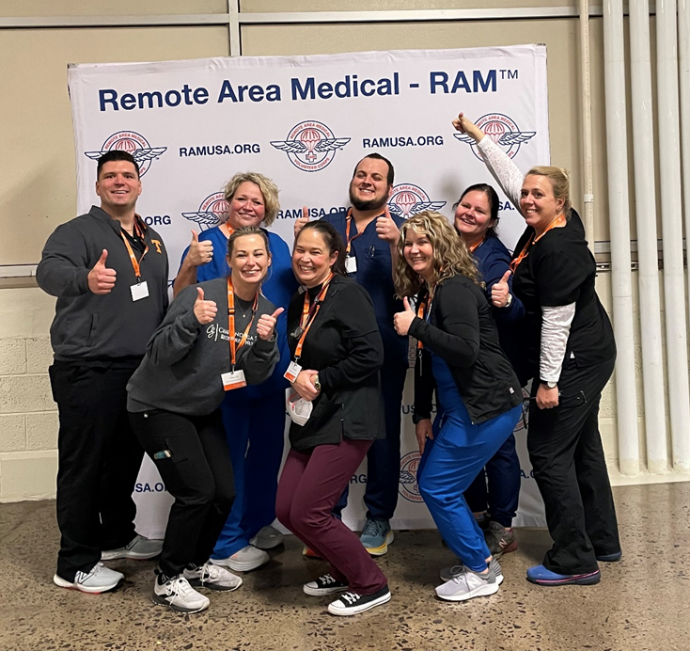
Eight RN to BSN students at the University of Tennessee, Knoxville participated in a RAM clinic.
The college partnered with RAM, to accomplish the goals of the eTHRIVE project. RAM is a major nonprofit organization whose mission is to prevent pain and alleviate suffering by providing free, quality healthcare to those in need.
The students had the opportunity to demonstrate their public health nursing skills with community members in the Knoxville area. The students worked in triage and assessed community members prior to receiving medical, dental, or vision services.
“I had the best experience at the RAM clinic,” said one student. “Not only does RAM provide access to care. Their one more patient mantra is at the heart of every volunteer. I was not only impressed by the wide range of services RAM offered, but the incredible level of dignity and respect they showed to every person was truly special.”
The Knoxville RAM clinic served over 800 community members during the three-day clinic held at the Knox Co Fair Grounds.

RAM Telehealth

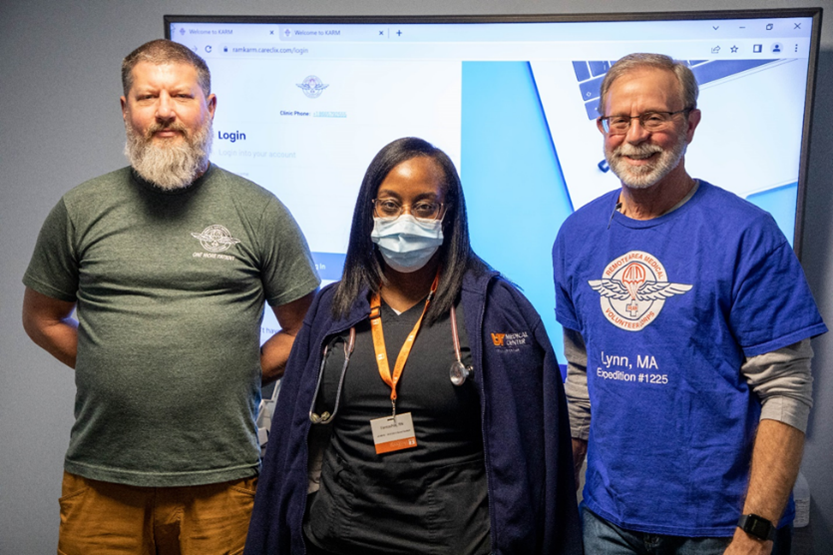
Another RN to BSN students chose to participate in clinical opportunities through RAM Telehealth. The telehealth model is site-based at Knoxville Area Rescue Ministries (KARM). RAM Telehealth offers telehealth visits for KARM guests every Monday and Wednesday afternoon.
A nurse is present with the guest while the provider participates from several states across the country. This model allows the nurse to provide hands-on care and assessment in conjunction with interdisciplinary communication and plan of care development with the provider.
“Telehealth was not a form of nursing I had been exposed to,” said an eTHRIVE student. “Seeing the nuisance of this type of care and how our relationship with technology has been combined with healthcare was interesting. I could see their assessment style in this environment and even explored a digital stethoscope and camera utilized to allow a physician to join the assessment remotely.”
Students were able to use some of the telehealth tools, such as a digital stethoscope and otoscope that were purchased for RAM through the eTHRIVE grant to enhance the quality of assessment and care.

Virtual Simulation

The final opportunity allowed students to participate virtually with the simulation team at the college. Twenty-three students interacted with two live standardized patients in the community setting.
“I felt like I learned a great deal about things that I normally wouldn’t deal with as an ER nurse,” said one student.
Each scenario was followed by rich debriefing highlighting the importance of consideration of social determinants.
“On behalf of the entire eTHRIVE team, we wish to express our sincere appreciation to Remote Area Medical, the UT simulation team, and Dr. Green-Laughlin for the incredible support and involvement in this rich learning opportunity for the RN-BSN students” said Lisa Davenport, eTHRIVE Project Director.


CONTACT:
Kara Clark Cardwell (865-974-9498, [email protected])

Precious Prints Project Welcomes First Academic Partner

Faculty and nursing students from Union University and UT.

In eight years, the Precious Prints Project has brought comfort to more than 950 Knoxville-area families who have experienced the loss of a child. Now a new partnership will take the project beyond East Tennessee.

The Precious Prints Project comforts grieving families with a sterling silver pendant bearing the fingerprint of their child. The project was developed at the University of Tennessee, Knoxville, College of Nursing in partnership with Precious Metal Prints, a local business. First launched at East Tennessee Children’s Hospital in January 2012, it has expanded to include all major health systems in Knox County, with fundraising and project management handled by the Student Nurses Association.

In response to wide-ranging inquiries from organizations interested in establishing a similar program, Dean Victoria Niederhauser and Clinical Instructor Lynne Miller developed a plan to take the Precious Prints Project to a national level. They developed two models of delivery—one for nursing schools and one for health care facilities.

Following months of planning, the UT Student Nurses Association is excited to welcome Union University Hendersonville College of Nursing as their first academic partner. Union will expand the project to the Nashville area as nursing students from both universities work together to implement the project.

Nursing faculty and student representatives from Union University recently visited UT to learn strategies for implementation, best practices, how to conduct staff education and training, and to visit one of UT’s partnering hospitals to learn about the process first-hand.

To learn more about the Precious Prints project, contact Lynne Miller at [email protected].

2019 Belize Blog: Expectations

Our last day of clinic was today! We were back in the Ontario community, where we saw a total of 47 patients. Some patients were those that received tickets yesterday, and others were walk-in’s. Most of the patients brought their family with them to be seen as well.

One of the differences we noticed in this community compared to the community of Arenal was that we saw more men in the clinic. Also, a lot of the kids and parents made appointments for later in the day because most of them had school to attend. More of the homes in Arenal cooked with stoves rather than fire and we saw more opportunities for work with Belmopan and San Ignacio nearby.

Today we talked about what our expectations for the trip were and what we are taking away from it. Some of the students shared their expectations and take-aways…

  • My assessment skills have really improved this week. I learned way more than I expected especially about pediatrics.
  • I was able to carry out a proper assessment while speaking Spanish.
  • I didn’t have any expectations coming in except that I was excited to learn about another country and common illnesses. I learned many new non pharmaceutical methods. I also learned more about health and wellness in pregnant women including what a normal range for blood pressure and pulse.
  • I thought it would be more difficult to conduct a history and assessment of a patient when we don’t speak the same language but it was easier than I thought
  • I expected there to be more serious ailments and underestimated the impact less severe ones could have on people’s daily lives in their current living conditions.
  • I expected less Spanish speaking people and was surprised how much Spanish translating we did. It was a pleasant surprise because I was able to take the lead on assessments and practice my Spanish.
  • I was expecting a surplus of opioid addiction like in America but was surprised to hear that it is not the case at all.
  • I was surprised that several of the patients wouldn’t take asthma meds or insulin because they were worried about becoming addicted.
  • I was surprised at the lack of emergency services like an ambulance.
  • I was surprised that we heard on multiple occasions that the number one thing health professionals would change/fix in their country is diet (especially less cokes and alcohol) rather than something like a better water system.
  • I came into this trip expecting the health assessment and explaining the patients case to the physician would be very challenging, however it ended up pushing me to work hard and I learned so much from my patients, the translators, and the doctors. I am able to take home with me better assessment skills, a broader Spanish knowledge, and more improved communication skills with patients.

Overall, this has been one of the best learning experiences we could have had for a study abroad trip! We have had the chance to learn and practice some of our medical Spanish, improved so much on our assessment skills, whitness how nursing and health care in another country compares to the United States, and continue to grow in our nursing career.

Having Drs. Carrie Bailey and Karen Lasater with us this week has been so helpful and they have taught us so much. Also, Dean Niederhauser has so many incredible skills and advice to share with us.

Tomorrow, we will be heading to Caye Caulker for some relaxation and snorkeling and then we head back for the States on Saturday!

–Kate Klein, BSN Student

2019 Belize Blog: Beautiful Things

Today we visited Ontario. A community 30 miles east of San Ignacio. The community had a lot of similarities to Arenal, but had differences too. There were two churches in the community, many people weren’t home because they were out working, there was sewer, and no one cooked with fire inside the home. The people in this community had more opportunities for work with Belmopan and San Ignacio nearby. We offered 40 appointments to the community in a short amount of time proving that even though this was a more established community, the need for health care was evident.

During our community visits we went to one house where the family had very little; however, when we arrived, a 78 year-old man took the time to pull out chairs for each of us to sit down while we talked. This kind gesture was a true testament to the beauty and kindness of the people of Belize.

Dorothy, a 98 year-old woman.

After community visits we had some fun zip lining and cave tubing (something the students had been anxiously awaiting all week). It was during this time, in the calm darkness of the cave and the exciting view from a cable 50 feet in the air, that we had time to reflect on the beauty around us. Whether it was the jungle canopy, the clear crisp river water, the cave ceilings dotted with glistening crystals, the exciting stories about the Mayan underworld, or the 98 year old woman in Ontario that welcomed us with open arms, there was beauty everywhere.

2019 Belize Blog: Successes & Challenges

Our first day of clinics in Arenal community! We saw a total of fifty-five patients ranging from newborns to elders 80+ years of age! Some patients from the Belizean community and those who came across the Guatemalan border had appointments that we distributed yesterday, others arrived without appointments seeking care. Appointment or not, no one was turned away. We set up five health stations and students conducted review of symptoms and physical assessments prior to being seen by the physician. We also had students assigned to triage and the pharmacy. The patients presented with a variety of symptoms and illnesses, for example coughs, colds, fevers, stomachaches, rashes, toothaches, infectious diseases, high blood pressure, diabetes, and pain.

At the end of the day we talked about things that went well and challenges we faced today. Some of our thoughts were….

  • It was challenging trying to remember everything we learned in health assessment and asking all of the relevant questions based on the presenting illness.
  • I was excited that I came up with the same correct diagnosis as the physician came up with for the patient!
  • Sometimes, medical complaints are lost in translation [from Spanish to English].
  • It was a challenging working with children who were either crying, were scared, and/or uncomfortable with the situation.
  • I was able to conduct a health assessment on a baby for the first time!
  • It was challenging to build trust with a patient so they are comfortable giving intimate details about a condition that may be embarrassing.
  • I identified a foreign object in a child’s ear canal and observed the removal of it!
  • Still working on speaking Spanish! I like to tell patients directly what I am doing during an exam, at times it is frustrating to use an interpreter to communicate my actions.
  • I palpated an enlarged lymph node on a patient for the very first time!
  • A challenge was all the bugs! We are working in a very different environment than I am used to….

We also talked about what worked well and what might be changed tomorrow in our clinic flow. We have a new game plan for tomorrow that we feel might work better to improve the efficiency of the clinic!

We had a bit of excitement when we lost power at our guest house this evening while hearing about nursing in Belize from a Public Health Nurse! Luckily we did not have to spend too long using our cell phone flashlights!!

We are excited to return to Arenal in the morning for another day providing health care and education to the community!

2019 Belize Blog: Trying New Things

Today, our first day in the rural community we will serve for the next 3 days, we ventured into many new experiences including trying different FOODS, exploring new PLACES and learning new THINGS!

FOODS

We started off the day with Belizean Fry Jacks with our eggs and refried beans for breakfast! And they were a big Hit! And, some adventurous students tried Tamarind, a tangy sweet-sour pod-like fruit that contains an edible pulp used in cuisines around the world. Cow’s foot soup anyone? Yep, Clint ventured out of his comfort zone to try this popular Belizean dish at lunch!

PLACES

We drove about 60 minutes from San Ignacio to where the road turns to dirt to reach the community of Arenal. Nestled on the Belize-Guatemala border, Arenal is one of the poorest villages in the country. We divided into 3 groups and walked from home-to-home assessing the health of families. If there were sick household member, we scheduled appointments for clinic visits for the next 2 days. After finishing our home visits, we visited the Myan ruin Xunantunich in the town of Cayo, the 2nd tallest structure in Belize. We learned about the history of this amazing historical and archeological Myan site and braved the 90+ degree weather to climb to the top of the ruins to experience majestic views of Guatemala and Belize. At the ruins, we saw iguanas, foxes, and monkeys; the howler monkeys chanted in the distance and many said they sounded exactly like “Chewbacca” from Star Wars!!

THINGS

We learned many new things on our journey! Our students said:

  • I heard a heart murmur for the first time;
  • I learned how to do Belizean dancing [we had lessons last evening, lots of hip movements]!;
  • This was my first time making a heartfelt, meaningful connection with a local family because we were able to talk in Spanish;
  • It was my first time being able to have one foot in two different countries (Guatemala and Belize);
  • During our home visits we were able to see first-hand how living conditions and the environment can affect people’s health [poor sanitation, open fires for cooking in house place families at risk for fires and cause smoke that can affect respiratory conditions];
  • This was my first time meeting a woman who had 21 children;

In addition, we were introduced to the community midwife who delivers many babies in the community and for some students it was their first time learning about a health care system outside of the United States. We look forward to starting our clinics in Arenal tomorrow!

So far, our journey has been “UNBELIEZABLE”!

Student Spotlight: Michael Curtis


The UT College of Nursing shines a spotlight on senior BSN student Michael Curtis from Memphis, TN. Curtis serves as Student Body Vice President and will graduate in May.

Michael Curtis

Q: What led you to pursue a degree in nursing?

A: Initially, I was drawn to the career by the application of science and mathematics in the profession–I enjoy learning about the human body and solving complicated mathematical equations. My interest in nursing was solidified when I was diagnosed with Type 1 Diabetes Mellitus. The nurses at LeBohner Hospital were so nice and respectful and considerate of my situation. As an eleven year-old child at the time, they made my complicated condition understandable and helped me realize the great impact of nurses–they can encourage, uplift, and restore through the power of their care!

Q: Tell us about a project or organization that you are involved with at UT or in the community.

A: I am involved with Leadership Knoxville Scholars at the university, which provides an avenue for connection to the Knoxville community. Currently, I am completing a community action project at Ijams Nature Center where I volunteer to maintain the environment by removing invasive species, replanting engendered species to more appropriate areas, and overseeing park cleanliness. I also lead interested groups in community service projects.

Q: What have you learned during your time in the UT College of Nursing that has made a difference to you?

A: The curriculum has challenged my way of thinking. Specifically, the Transcultural Nursing and Maternal Nursing courses have made a significant difference in my perspective of life and the nursing profession. Prior to my experiences in the College of Nursing, I did not express empathy or intentionality to others in need of health care. I also took health care for granted, as I did not have to worry about sickness/disease and its financial implications. I have learned that people need more than just procedures or surgery—they need holistic nursing care including empathy and passion that will help restore and maintain good health. Now that I have a better understanding of the potential impact a nurse can have on a patient and their family, I desire to be the change in health care—always being willing to do more for my patients in all situations.

Q: What do you want to do after graduation?

A: I would like to work in a health care facility for two to three years in one of the following areas: critical care unit, emergency department, labor/delivery, or mother/baby. I would then like to pursue a graduate degree.

Q: Is there anything else you would like to share about your experience at UT?

A: I am grateful for all of my experiences within the College of Nursing, including participation in the Nursing Honors Program and the opportunity to conduct research. I also founded a student organization and am currently serving as Student Body Vice President and these experiences are propelling me to be the individual I that I aspire to be. I am grateful for the faculty and students that I have had the opportunity to work with at UT. Their knowledge, wisdom and compassion has inspired me to do more for the community and the nursing profession. My life will never be the same, and I am grateful for that!